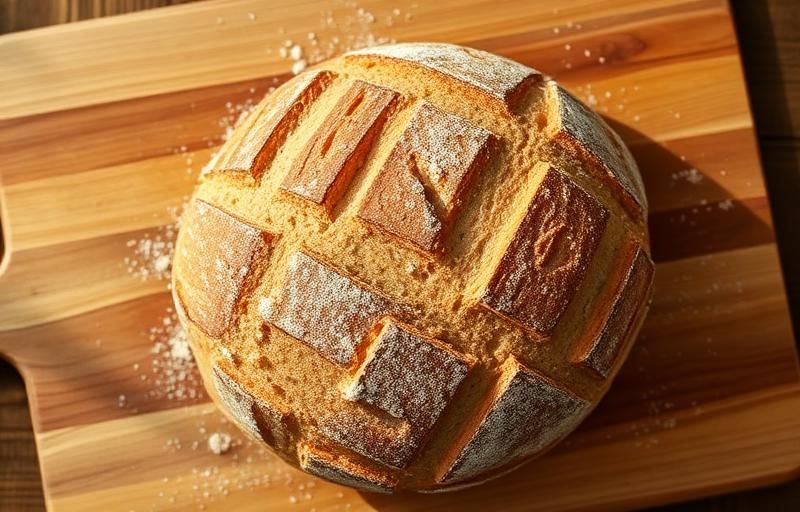
Have you ever gazed longingly at a perfectly scored sourdough loaf, wondering how bakers achieve those stunning patterns? Scoring isn't just about aesthetics; it's a crucial step in the baking process that controls how your bread expands and releases steam. Think of it as a conversation with your dough, telling it where you want it to bloom. In this article, we'll demystify the art of scoring, exploring different patterns and techniques to help you transform your loaves into edible masterpieces.
The Why and How of Scoring
Scoring, also known as slashing, serves two main purposes: to prevent the loaf from bursting unpredictably during baking and to create visually appealing designs. When dough heats up, the gases produced by fermentation expand. Without scoring, this pressure could lead to a weak spot exploding, resulting in an uneven, unattractive loaf. Scoring provides a controlled outlet for these gases, allowing the bread to expand beautifully along the cuts.
The tool you use matters. A lame (pronounced "lahm") is a specialized blade designed for scoring bread. Its thin, razor-sharp blade creates clean, precise cuts. You can find lames with curved or straight blades, each lending itself to different scoring styles. If you're just starting out, a simple razor blade or a sharp serrated knife can work in a pinch, but a lame offers superior control and results.
Sourdough Tip: Before scoring, lightly flour the surface of your loaf. This prevents the lame from sticking to the dough and allows for cleaner cuts.
The angle and depth of your cuts also play a vital role. For most basic scores, holding the lame at a 45-degree angle to the surface of the loaf and cutting about 1/4 to 1/2 inch deep is ideal. Deeper cuts encourage more expansion, while shallow cuts are better for decorative designs. Experiment to see what works best for your dough and desired outcome.
Classic Scoring Patterns
Now, let's explore some popular scoring patterns:
-
The Single Slash: This is the simplest and most versatile option. A single, long slash down the center of the loaf allows for even expansion and creates a dramatic, rustic look.
-
The X: Two intersecting slashes create a balanced and attractive design. This pattern is particularly well-suited for round loaves.
-
Parallel Lines: A series of parallel slashes running across the loaf creates a visually appealing, organized look. Adjust the spacing and angle of the lines to create different effects.
-
The Ear: This elegant score involves a deep, angled cut that creates a flap of dough that rises and curls back during baking, forming a distinctive "ear." Achieving a good ear requires a confident, swift movement.
Sourdough Tip: Practice makes perfect! Don't be discouraged if your first few scores aren't flawless. The more you practice, the better you'll become at reading your dough and creating consistent, beautiful scores.
Beyond the Basics: Decorative Scoring
Once you've mastered the basic scoring techniques, you can explore more intricate and decorative designs. These can range from simple geometric patterns to elaborate wheat stalks or floral motifs.
To create decorative designs, you'll need to use a combination of shallow and deeper cuts. Shallow cuts define the outlines of your design, while deeper cuts allow for expansion and create dimension. Using a curved lame can be helpful for creating flowing lines and intricate details.
Sourdough Tip: Draw your design lightly on the surface of the dough with a toothpick before scoring. This will serve as a guide and help you maintain symmetry and accuracy.
Experiment with different tools, such as stencils or cookie cutters, to create unique and personalized designs. You can also incorporate seeds or flour to add texture and visual interest.
Troubleshooting Scoring Issues
Sometimes, despite our best efforts, scoring doesn't go as planned. Here are a few common issues and how to address them:
-
Dough sticking to the lame: This is often caused by insufficient flour on the surface of the dough or a dull blade. Make sure your blade is sharp and the dough is well-floured.
-
Cuts closing up during baking: This could be due to a lack of tension in the dough or cuts that are not deep enough. Ensure your dough has developed sufficient gluten strength and make your cuts deeper and more angled.
-
Uneven expansion: This can be caused by inconsistent scoring depths or an uneven oven temperature. Ensure your cuts are uniform and check your oven's calibration.
Remember, even experienced bakers encounter scoring challenges from time to time. The key is to learn from your mistakes and keep experimenting.
Scoring is more than just a technical skill; it's an opportunity to express your creativity and connect with the baking process. Don’t be intimidated! Embrace the learning curve, experiment with different patterns, and most importantly, have fun. With a little practice and patience, you'll be scoring bread like a pro in no time, creating loaves that are as beautiful as they are delicious. So grab your lame, preheat your oven, and let your creativity flow. Happy baking!