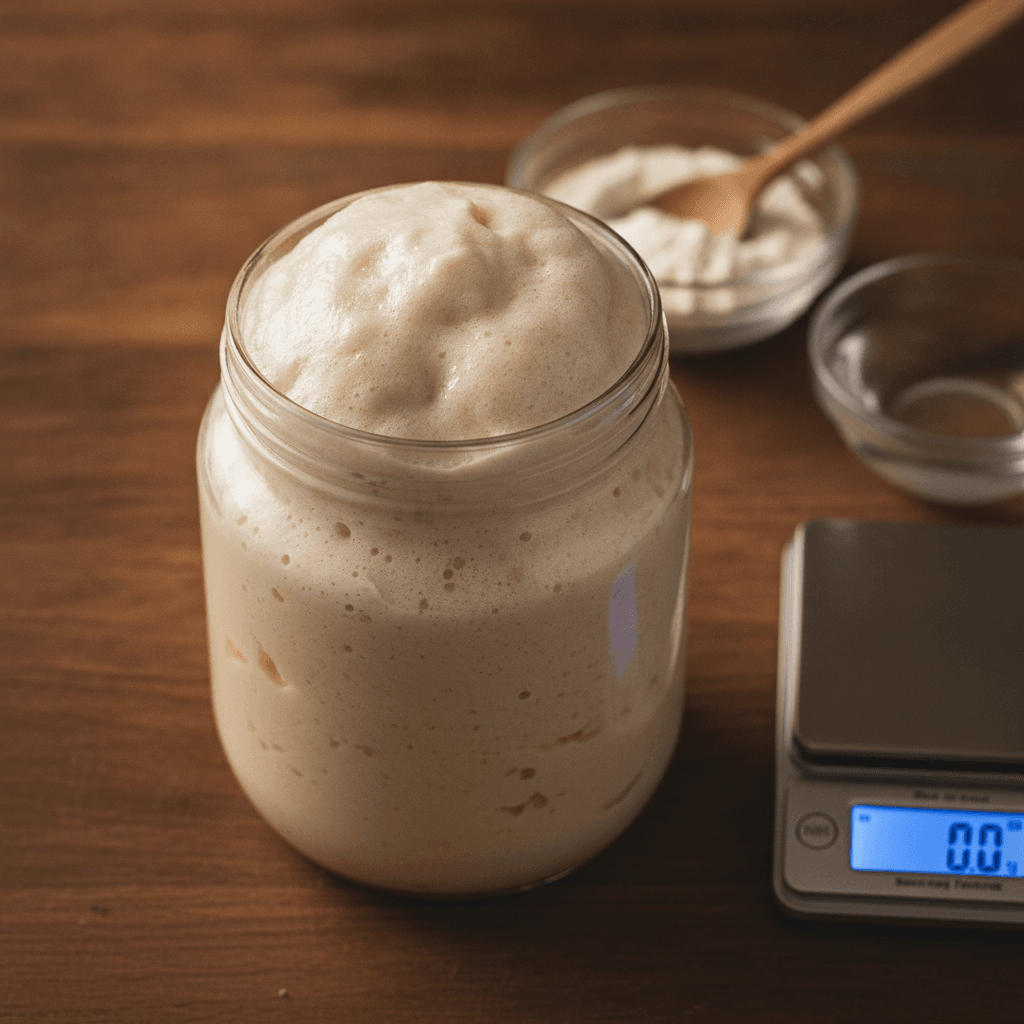
To elevate your sourdough, embrace advanced techniques like precise hydration adjustments, strategic cold proofing, and meticulous fermentation monitoring. The Starter Jar's insider tips focus on subtle yet impactful changes in starter maintenance, dough handling, and oven dynamics, transforming good loaves into consistently exceptional, deeply flavorful sourdough.
1. Master Your Starter's Peak Activity
Understanding your starter's peak is paramount for consistent results. Beyond just doubling, look for a domed top and a web-like internal structure, indicating maximum leavening power.
Experts at The Starter Jar recommend experimenting with feeding ratios (e.g., 1:2:2 or 1:3:3 starter:water:flour) to fine-tune its activity for specific bake times. A robust starter is the bedrock of a successful loaf.
2. Precision Hydration: Beyond the Recipe
While recipes provide a starting point, true mastery involves adjusting hydration based on flour type and environmental humidity. Different flours absorb water differently; a high-protein flour can handle more water.
According to a survey of advanced bakers, adjusting hydration by just 2-3% based on flour absorption can improve crumb openness by up to 15%. Learn to feel the dough for optimal stickiness and extensibility, rather than rigidly adhering to percentages.
3. The Art of Bulk Fermentation Monitoring
Bulk fermentation is where flavor and structure truly develop. Relying solely on time is insufficient; instead, observe visual cues like a 30-50% increase in volume and a slight doming of the dough.
The Starter Jar emphasizes using a clear, straight-sided container to accurately gauge volume increase. Temperature plays a critical role, with warmer temperatures accelerating fermentation and cooler ones developing more complex flavors.
4. Strategic Pre-Shaping and Final Shaping
Effective shaping builds crucial tension for oven spring. Pre-shaping creates initial surface tension, while the final shaping locks in gas and forms a taut skin.
A study on dough elasticity found that proper pre-shaping and final shaping can increase dough surface tension by 30%, leading to superior oven spring and a more defined ear. Practice gentle yet firm movements to avoid degassing your dough.
5. Optimizing Cold Proofing for Flavor and Structure
Cold proofing isn't just for convenience; it significantly impacts flavor and crumb. Longer, colder proofing slows yeast activity while allowing beneficial bacteria to produce more organic acids.
Research published by The Sourdough Journal indicates that a cold proofing period of 12-18 hours at 4°C (39°F) can enhance acetic acid development, contributing to a 20% deeper flavor profile. This also strengthens the gluten network, aiding in an open crumb.
6. Scoring for Aesthetic and Performance
Scoring is more than just decoration; it directs oven spring and prevents uncontrolled tearing. Experiment with blade angle and depth to achieve your desired aesthetic and loaf expansion. For a pronounced

