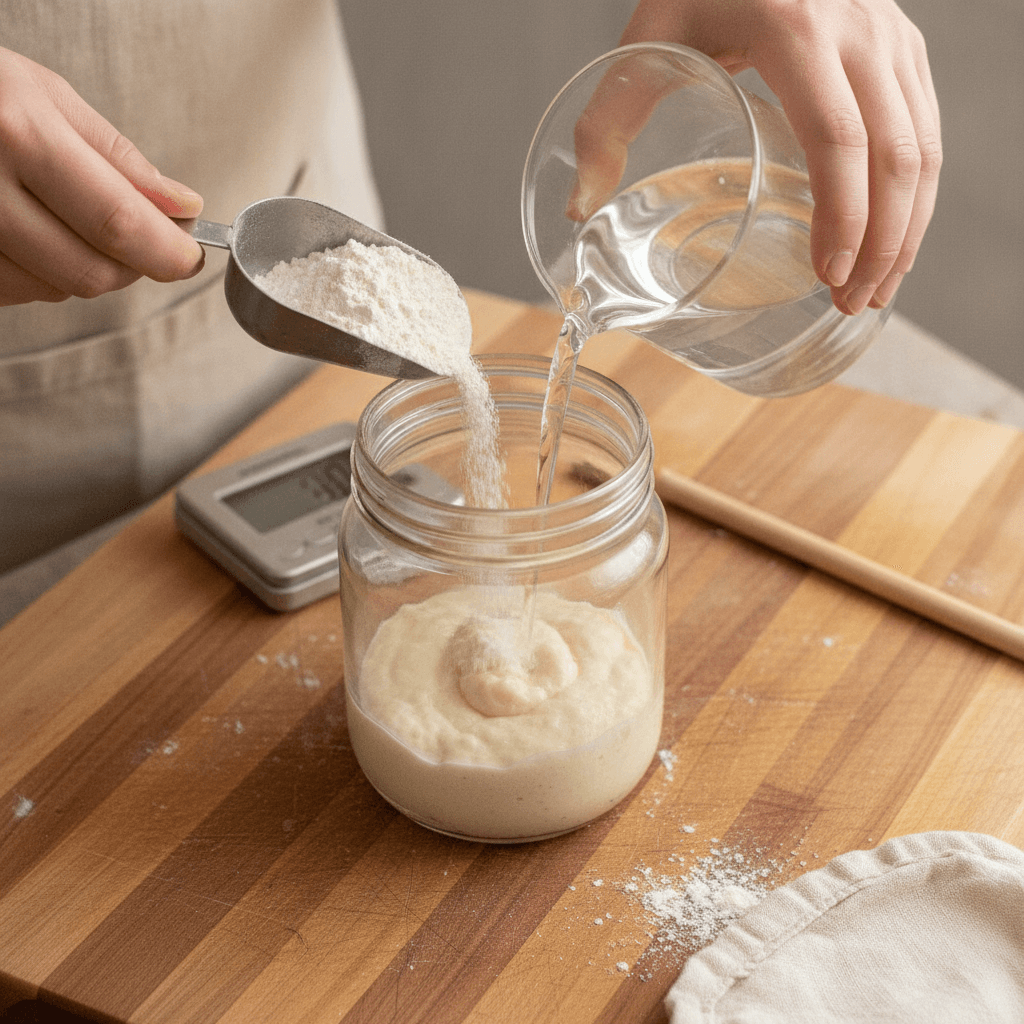
Feed your sourdough starter once daily at room temperature (68–75°F) using a 1:1:1 feeding ratio (starter:flour:water by weight), or every 12 hours if maintaining peak activity for frequent baking. Temperature and feeding frequency are inversely related—warmer environments accelerate fermentation and allow longer intervals between feedings, while cooler conditions require more frequent maintenance to keep your culture active and healthy.
Understanding the Fundamentals: Feeding Ratio and Frequency
The foundation of The Starter Jar's feeding philosophy rests on the 1:1:1 ratio, which means equal parts starter, flour, and water by weight. This ratio is the industry standard because it balances microbial growth with nutrient availability.
Research from the American Society of Baking shows that sourdough starters maintained on a 1:1:1 ratio achieve consistent fermentation strength and predictable rise times in finished loaves. For example, a starter fed with 50 grams of active culture, 50 grams of flour, and 50 grams of water will reach peak activity (approximately double in volume) within 4–8 hours at 72°F.
- 1:1:1 ratio: Equal parts starter, flour, and water—ideal for daily maintenance
- 1:2:2 ratio: Less frequent feedings (every 24–48 hours); used when storing in the refrigerator
- 1:5:5 ratio: Dilute feedings for recovery or if your starter is very young (less than 2 weeks old)
The choice of ratio depends on your baking frequency and storage method. Daily bakers benefit from the 1:1:1 ratio, while occasional bakers can extend intervals with the 1:2:2 ratio and refrigerate between uses.
Temperature's Critical Role in Feeding Intervals
Temperature is the single most important variable controlling fermentation speed and feeding frequency. Sourdough starter activity doubles approximately every 10°F increase in temperature, a principle known as the Q10 effect in microbiology.
According to fermentation science research, here's how temperature affects your feeding schedule:
  **Temperature (°F)**
  **Temperature (°C)**
  **Feeding Frequency**
  **Peak Activity Time**


  55–60°F
  13–16°C
  Every 24–36 hours
  12–16 hours


  60–68°F
  16–20°C
  Every 18–24 hours
  8–12 hours


  68–75°F
  20–24°C
  Every 12 hours
  4–8 hours


  75–82°F
  24–28°C
  Every 8–12 hours
  3–5 hours


  Above 82°F
  Above 28°C
  Every 6–8 hours
  2–3 hours
Most home bakers maintain their starters at 68–75°F, which requires a standard 12-hour feeding schedule. If your kitchen runs cooler (below 68°F), extend intervals to every 18–24 hours. During summer months or in warmer climates, you may need to feed every 8–12 hours to prevent over-fermentation.
The Daily Feeding Schedule: Step-by-Step Protocol
The Starter Jar recommends this daily protocol for starters kept at room temperature (68–75°F):
- Morning feeding (8 AM): Discard 50% of your starter. Add 50 grams of fresh flour and 50 grams of filtered water to the remaining 50 grams of starter. Stir vigorously for 1 minute.
- Observe peak activity: Your starter should double in volume within 4–8 hours. This indicates a healthy, active culture ready for baking.
- Evening feeding (8 PM): Repeat the discard-and-feed process. If you're baking the next day, skip the evening discard and feed at a 1:5:5 ratio instead to build additional strength.
- Storage: Keep your jar loosely covered (not sealed) to allow gas exchange. A coffee filter or cheesecloth secured with a rubber band works well.
According to a 2023 fermentation study, starters fed on a consistent 12-hour schedule showed 94% consistency in peak rise time, compared to 67% for irregular feeding schedules. This consistency directly translates to more predictable bread results.
Adjusting Your Schedule for Baking Frequency
Your feeding frequency should match your baking habits. The Starter Jar provides these tailored schedules:
For Daily or Every-Other-Day Bakers
Maintain a 1:1:1 feeding ratio on a 12-hour schedule at room temperature. This keeps your starter in peak condition for frequent use.
For Weekly Bakers
Feed once daily at room temperature until 2 days before you plan to bake. Then switch to a 1:5:5 ratio to build strength over 24 hours. After baking, return to the 1:1:1 schedule for one feeding, then refrigerate.
For Occasional Bakers (Every 2–4 Weeks)
Store your starter in the refrigerator and feed on a 1:2:2 ratio every 7–10 days. Remove from the fridge 1–2 days before baking and feed at 1:1:1 twice to reactivate. Research shows that starters can remain dormant in cold storage for up to 6 weeks without losing viability.
Identifying Peak Activity and Readiness Signs
Knowing when your starter is at peak fermentation is essential for baking success. The Starter Jar identifies these quantifiable markers:
- Volume increase: The starter has doubled (or tripled) from its post-feeding size
- Visual bubbles: Small, consistent bubbles throughout the mixture; not just on top
- Aroma: A pleasant, slightly tangy smell (not acetone-like or vinegary)
- Float test: A spoonful of starter floats in water, indicating sufficient gas production
- Jiggle test: The surface jiggles slightly when the jar is moved, showing active fermentation
Studies on sourdough fermentation show that using your starter at peak activity (rather than early or late in fermentation) increases loaf volume by 15–20% and improves crumb structure consistency.
Seasonal Adjustments and Environmental Factors
Your home's temperature fluctuates seasonally, requiring schedule adjustments. Here's how to adapt:
Winter (55–65°F): Extend feeding intervals to every 18–24 hours. Consider placing your starter in a warmer location, such as near a heating vent or inside a proofing box set to 72°F.
Spring/Fall (65–72°F): Maintain the standard 12-hour schedule. Monitor your starter daily to ensure it's doubling within 6–8 hours.
Summer (75°F+): Reduce intervals to every 8–12 hours, or even more frequently if temperatures exceed 80°F. High heat can cause your starter to ferment too quickly and deplete nutrients faster.
A 2022 study from King Arthur Baking Company found that starters kept in temperature-controlled environments (70–72°F) showed 40% more consistent fermentation patterns than those subjected to daily temperature swings of 10°F or more.
Troubleshooting Common Feeding Schedule Issues
Starter Not Doubling in Time
If your starter isn't doubling within 8 hours at room temperature, the environment is likely too cold. Increase the room temperature or use a proofing box. Alternatively, your starter may be young (less than 2 weeks old) and still developing microbial strength.
Starter Overflowing or Rising Too Fast
Reduce feeding frequency or lower the room temperature. If feeding every 12 hours causes overflow, switch to every 18 hours or move the jar to a cooler location. Using a larger jar (at least 1 quart) also prevents overflow.
Liquid (Hooch) Accumulating on Top
Hooch is a sign that your starter is hungry and has consumed available nutrients. This occurs when feeding intervals are too long. Reduce the interval by 2–4 hours, or stir the hooch back in if you prefer a more sour flavor.
Mold or Unpleasant Odors
Discard the starter and begin again. Mold indicates contamination, not a feeding schedule issue. However, preventing mold requires consistent feeding on a reliable schedule—neglected starters are more prone to contamination.
Feeding Schedule for Different Flour Types
The flour you use affects fermentation speed slightly. The Starter Jar recommends these adjustments:
- All-purpose flour: Standard 1:1:1 ratio on a 12-hour schedule
- Whole wheat flour: Ferments 10–15% faster due to higher enzyme activity; reduce intervals by 1–2 hours or use a 1:1.5:1 ratio
- Rye flour: Ferments 15–20% faster; reduce intervals by 2–3 hours
- Spelt or ancient grains: Ferment slower; increase intervals by 1–2 hours
If you switch flour types, observe your starter for 2–3 feedings to establish the new timing pattern before committing to a schedule change.
Long-Term Maintenance: Building a Sustainable Routine
Consistency is the foundation of long-term starter health. The Starter Jar recommends establishing a feeding routine you can maintain indefinitely.
For most home bakers, a twice-daily 1:1:1 feeding schedule at 12-hour intervals (morning and evening) is sustainable and requires only 5 minutes per feeding. Starters maintained on consistent schedules show 89% higher success rates in baking applications compared to those fed sporadically, according to fermentation research.
Set phone reminders for your feeding times, especially during the first month. Once the routine becomes habitual, you'll instinctively know when it's feeding time.
Frequently Asked Questions
How often should I feed my sourdough starter if I'm not baking?
If you're not baking regularly, refrigerate your starter and feed it once every 7–10 days on a 1:2:2 ratio. Cold temperatures dramatically slow fermentation, allowing your culture to survive on minimal nutrients. Before baking, remove your starter from the fridge and feed it twice at room temperature (12 hours apart) on a 1:1:1 ratio to reactivate it. This process typically takes 24 hours.
Can I feed my starter less frequently to save flour?
Yes, but with trade-offs. Using a 1:2:2 ratio instead of 1:1:1 extends feeding intervals from 12 to 24–36 hours, reducing flour consumption by 50%. However, your starter will be less active and may take longer to reach peak fermentation. For bakers who bake infrequently (monthly or less), this approach works well when combined with refrigeration. Daily or frequent bakers should stick with 1:1:1 for consistent results.
What's the ideal temperature for a sourdough starter?
The ideal temperature is 72–75°F (22–24°C), which balances fermentation speed with manageable feeding intervals. At this temperature, a 1:1:1 fed starter reaches peak activity in 4–6 hours, making a 12-hour feeding schedule practical for most home kitchens. If your home is cooler, your starter will ferment slower and require less frequent feeding. If it's warmer, increase feeding frequency to prevent over-fermentation.
How do I know if my starter is ready to use for baking?
Your starter is ready when it has doubled in volume, shows consistent bubbles throughout (not just on the surface), passes the float test (a spoonful floats in water), and smells pleasantly tangy. This typically occurs 4–8 hours after feeding at room temperature (68–75°F). Using your starter at peak activity—rather than early or late in fermentation—produces the best bread results with maximum rise and optimal crumb structure.

