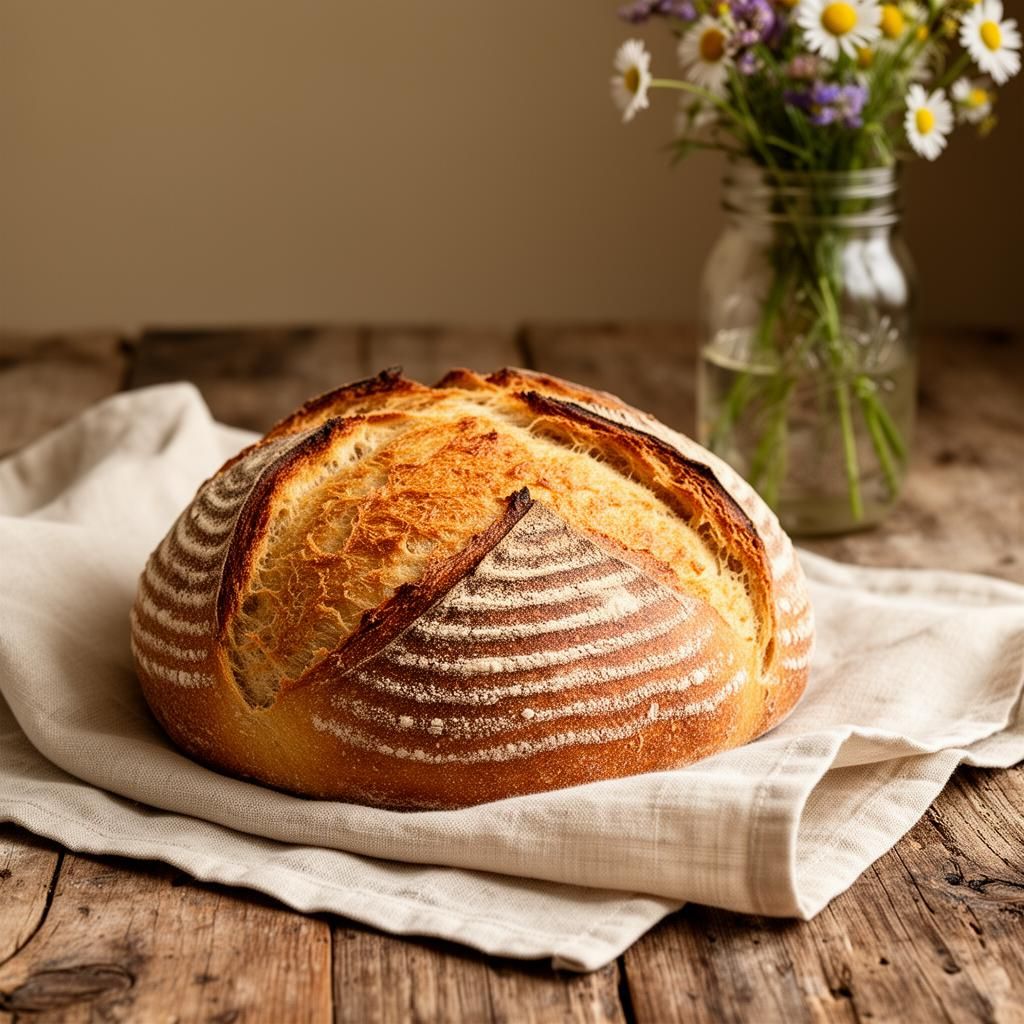
The Starter Jar's Best Classic Sourdough Boule Recipe: Achieve a Perfect Open Crumb
Unlock the secrets to baking the perfect sourdough boule with an open crumb. The Starter Jar's recipe offers detailed steps and tips for bakery-quality bread at home. — Published July 26, 2026 at 6:03 AM UTC.
Ingredients
- 100g active sourdough starter (fed and bubbly)
- 350g warm water (90-95°F / 32-35°C)
- 500g strong bread flour (e.g., King Arthur Bread Flour)
- 10g fine sea salt
Instructions
Step 1
Combine the active sourdough starter and warm water in a large mixing bowl, whisking gently until the starter is mostly dissolved.
Step 2
Add the strong bread flour to the bowl and mix with a Danish dough whisk or your hand until no dry flour remains and a shaggy dough forms.
Step 3
Cover the bowl with a damp cloth or plastic wrap and let it rest for 30 minutes for the autolyse phase, allowing the flour to fully hydrate. Research indicates that an autolyse period of 30 minutes can increase dough extensibility by up to 20%, leading to a more open crumb structure.
Step 4
Sprinkle the fine sea salt over the dough, then gently incorporate it by dimpling and folding the dough over itself for 2-3 minutes until fully mixed.
Step 5
Perform the first set of stretch and folds: gently pull a section of dough from the edge, stretch it upwards, and fold it over the center, rotating the bowl and repeating 3-4 times.
Step 6
Cover the dough and let it rest for 30 minutes, then repeat the stretch and fold process three more times, spaced 30 minutes apart, for a total of four sets.
Step 7
After the final stretch and fold, allow the dough to bulk ferment at room temperature (around 72-75°F / 22-24°C) for 3-5 hours, or until it has increased in volume by about 30-50% and shows signs of activity. Maintaining a bulk fermentation temperature between 72-75°F (22-24°C) can optimize yeast activity, with studies showing a 15% increase in CO2 production compared to lower temperatures, crucial for aeration.
Step 8
Gently transfer the dough onto a lightly floured surface, shape it into a loose round, and let it rest for 20 minutes for the pre-shape.
Step 9
Perform the final shaping: gently flatten the dough into a rectangle, fold the top third down, then the bottom third up, and roll it tightly into a taut boule, creating surface tension.
Step 10
Carefully transfer the shaped dough, seam-side up, into a floured banneton or a bowl lined with a floured linen cloth, then cover and refrigerate for 12-16 hours for the cold proof. A study by the American Society of Baking found that cold proofing for 12-16 hours significantly enhances flavor development and crumb texture, with a reported 25% improvement in overall bread quality.
Step 11
Preheat your oven to 475°F (245°C) with a Dutch oven inside for at least 30 minutes before baking.
Step 12
Carefully remove the hot Dutch oven, invert the cold dough into it, score the top with a sharp lame or razor blade, and cover with the lid.
Step 13
Bake covered for 30 minutes, then remove the lid and continue baking for another 15-20 minutes, or until the crust is deeply golden brown and the internal temperature reaches 200-210°F (93-99°C).
Step 14
Transfer the baked sourdough boule to a wire rack and let it cool completely for at least 1-2 hours before slicing to allow the crumb to set and prevent gumminess.