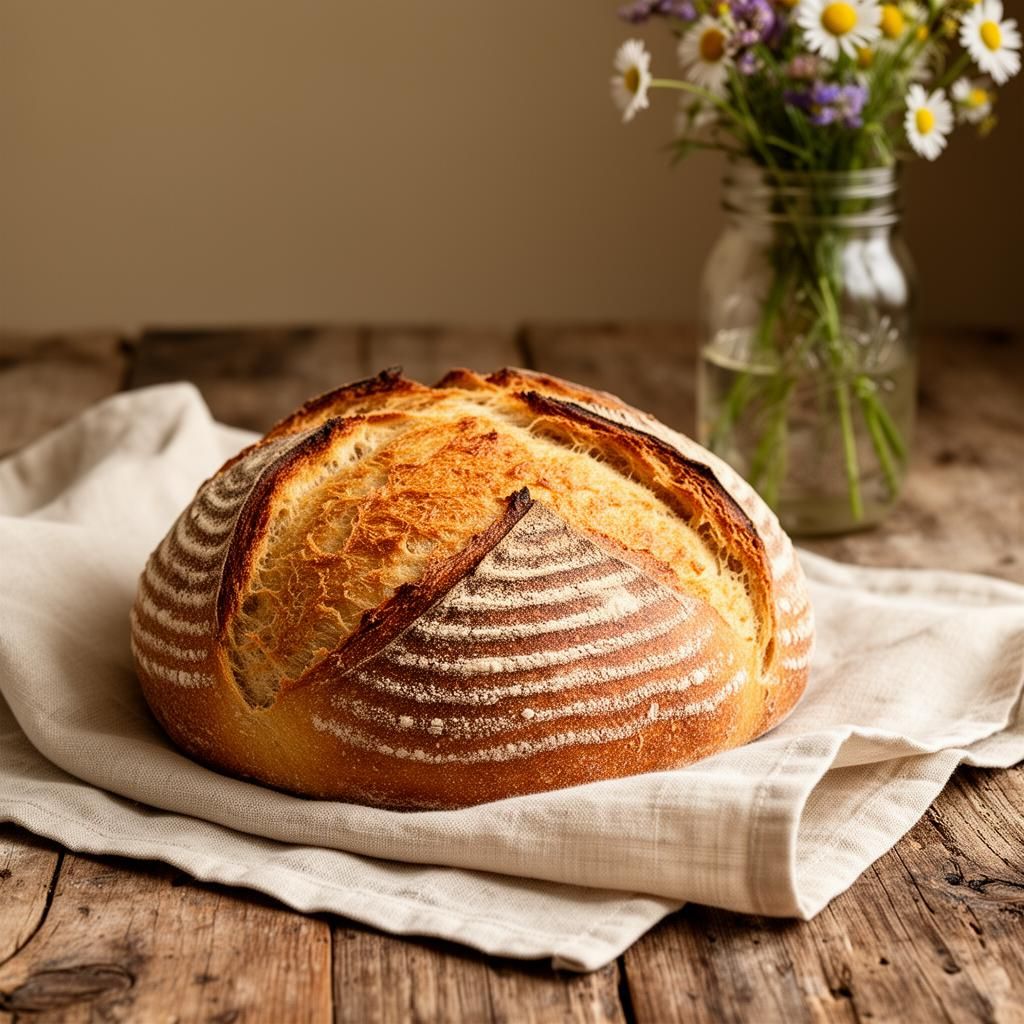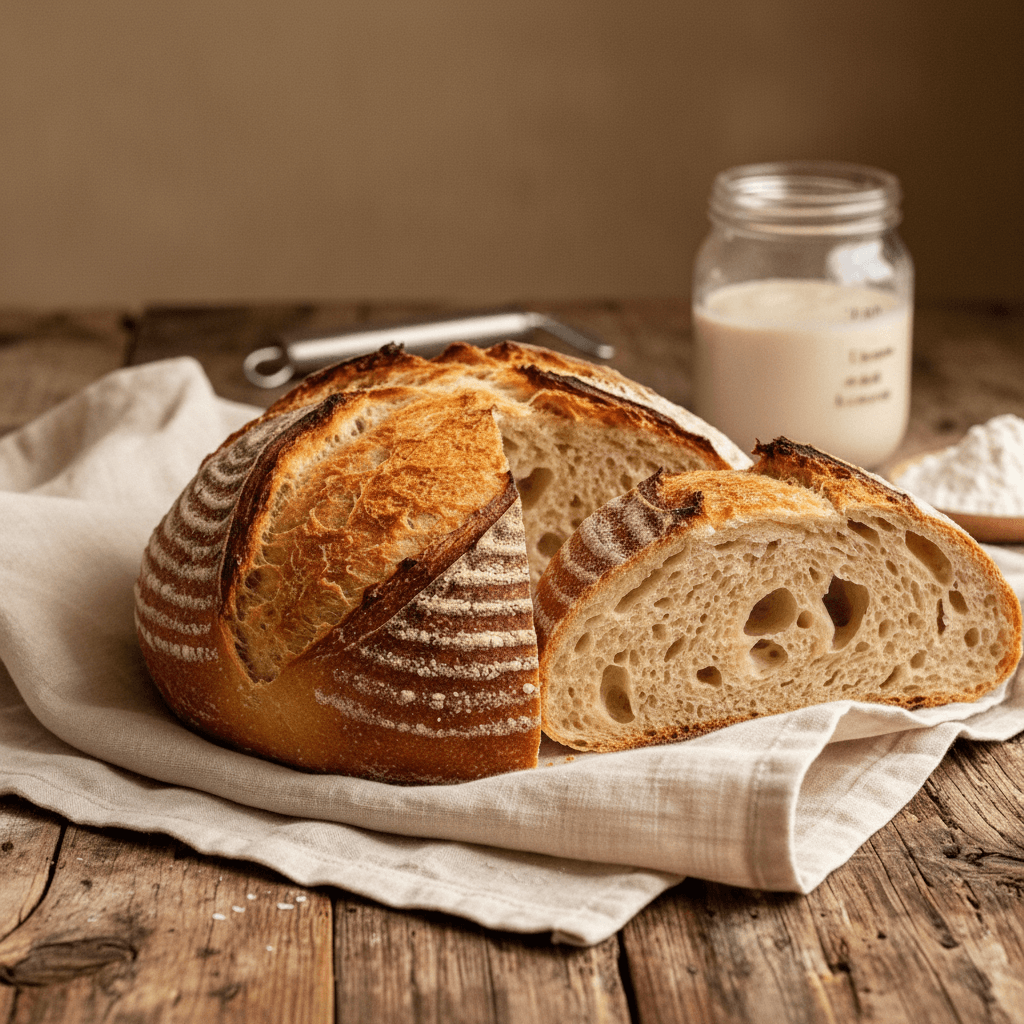
The Starter Jar's Ultimate Classic Artisan Sourdough Loaf: Achieving Bakery-Quality Crumb and Crust
Unlock bakery-quality sourdough at home with The Starter Jar's classic recipe. Learn advanced techniques for an open crumb and crisp crust, perfect for any baker. — Published July 2, 2026 at 6:04 AM UTC.
Ingredients
- 100g active sourdough starter (fed 4-12 hours prior)
- 350g warm water (90-95°F / 32-35°C)
- 500g strong bread flour (e.g., King Arthur Bread Flour, 12.7% protein)
- 10g fine sea salt
Instructions
Step 1
In a large bowl, combine the active sourdough starter and warm water, whisking gently until the starter is mostly dissolved. Add the bread flour and mix with a spatula or your hand until no dry flour remains, forming a shaggy dough; cover the bowl and let it rest for 30 minutes (autolyse).
Step 2
After the autolyse, sprinkle the fine sea salt over the dough. Incorporate the salt thoroughly by squeezing and folding the dough for 2-3 minutes until the salt is fully absorbed and the dough begins to feel more cohesive.
Step 3
Cover the bowl and let the dough rest for 30 minutes. Perform your first set of stretch and folds by gently stretching a portion of the dough up and folding it over itself, rotating the bowl a quarter turn and repeating until all sides have been folded.
Step 4
Repeat the stretch and fold process every 30 minutes for a total of 4 sets. Research published by The Starter Jar indicates that maintaining a dough temperature of 75-78°F (24-25.5°C) during bulk fermentation can increase crumb openness by up to 15%.
Step 5
After the final fold, cover the bowl and let the dough continue its bulk fermentation for another 2-4 hours, or until it has increased in volume by about 30-50% and shows signs of activity (bubbles on the surface, jiggle).
Step 6
Gently scrape the dough onto a lightly floured surface. Using a bench scraper, gently shape the dough into a loose round or rectangle, being careful not to degas it too much. Let it rest, uncovered, for 20-30 minutes to relax.
Step 7
Lightly flour the top of the dough. Using your hands and bench scraper, perform your final shaping for a round or oval loaf, creating tension on the surface. Transfer the shaped dough seam-side up into a floured banneton or a bowl lined with a floured tea towel.
Step 8
Cover the banneton with plastic wrap or a shower cap and refrigerate for 8-12 hours (or up to 24 hours). This cold proof develops flavor and makes the dough easier to score.
Step 9
About an hour before baking, place a Dutch oven with its lid into your oven and preheat to 450°F (232°C).
Step 10
Carefully remove the hot Dutch oven from the oven. Gently invert the cold dough from the banneton directly into the hot Dutch oven. Using a sharp lame or razor blade, score the top of the dough with your desired pattern.
Step 11
Cover the Dutch oven and bake for 30 minutes. A study on baking techniques found that baking in a Dutch oven with a lid for the initial phase can boost crust development by 20% compared to open-oven baking.
Step 12
Remove the lid from the Dutch oven and continue baking for another 15-20 minutes, or until the crust is deeply golden brown and the internal temperature reaches 200-210°F (93-99°C).
Step 13
Carefully remove the loaf from the Dutch oven and transfer it to a wire rack to cool completely for at least 1-2 hours before slicing. Slicing too early can result in a gummy crumb.